
Attic Spray Foam Insulation in Chattanooga, TN
Nobody understands the science of building better than Foametix. If you want to create a thermally efficient and air tight space, it's not enough just to insulate. You must choose the right insulation and air sealing system for the application, and be sure it's properly installed. Work with a veteran-owned insulation contractor in Chattanooga.
Spray Foam
Insulation in the Attic (Non-Vented Attic Spaces)
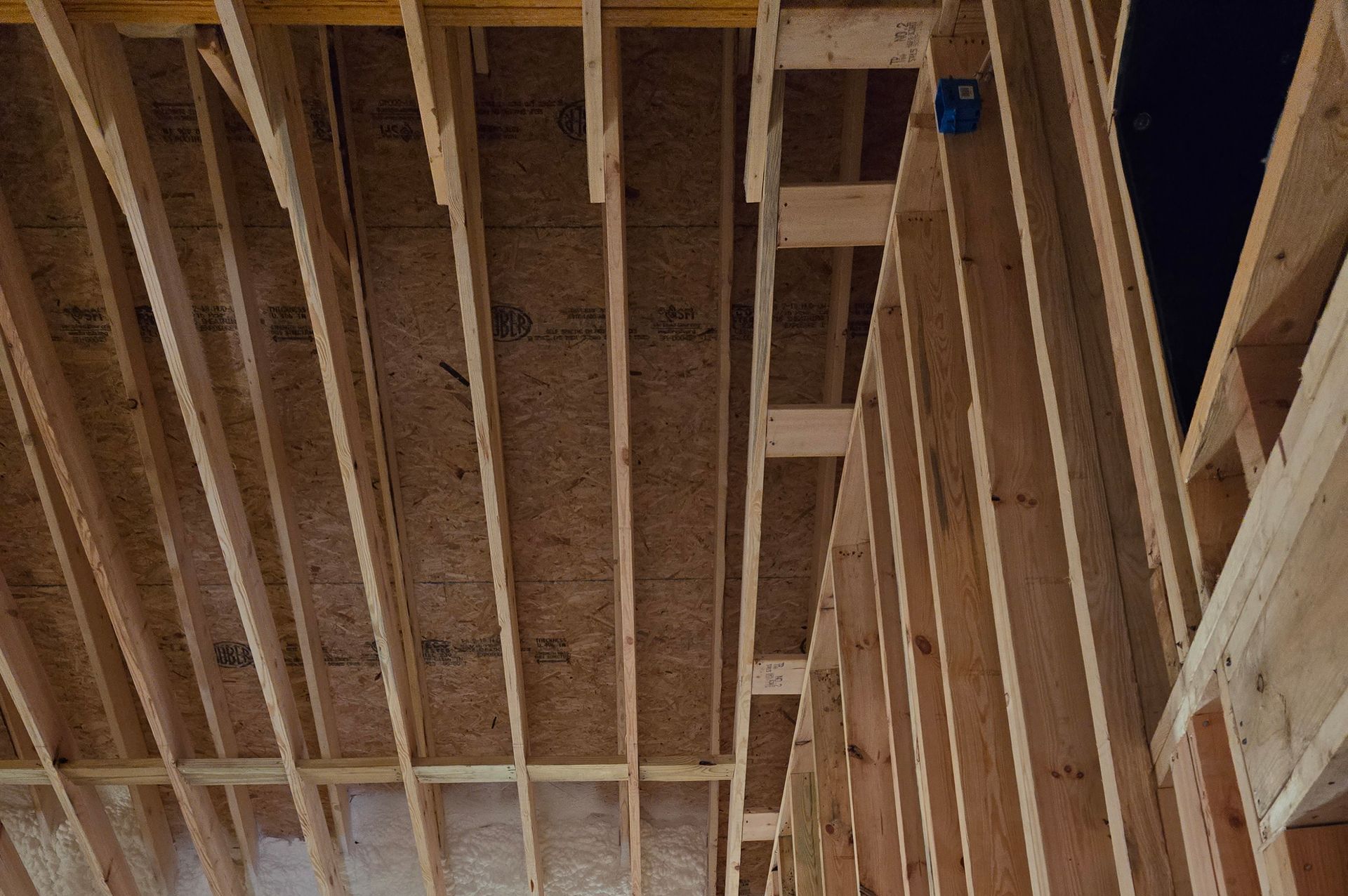
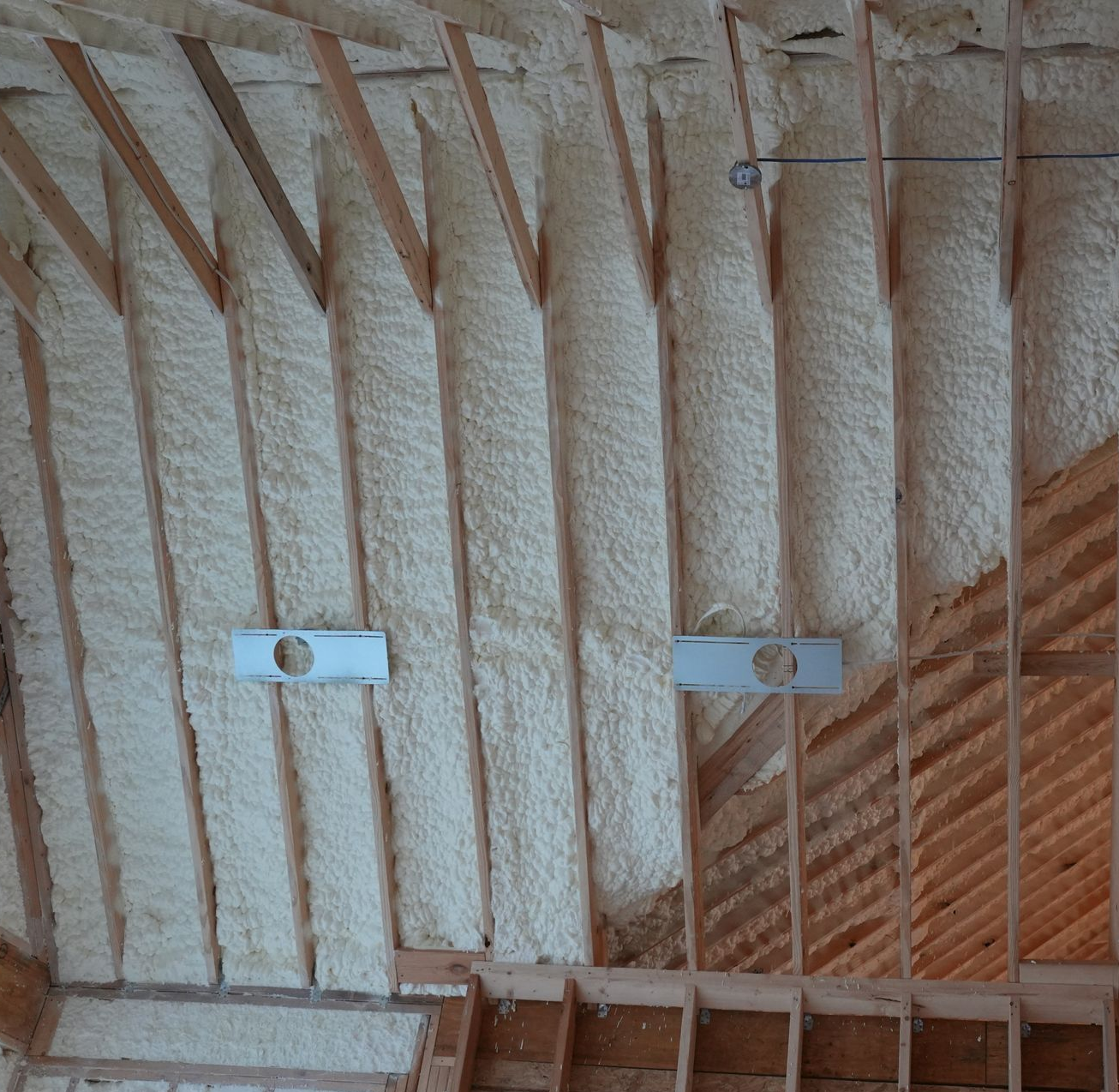
In this application, considered the most effective, by most of the SPF industry, the foam is sprayed directly to the underside of the roof between the joists, down around the rim and into the soffit areas, on the gable wall ends, and effectively sealing off and insulating the entire attic space from any air infiltration.
By now you have probably heard of this procedure with terms like: "Hot Roof design", Unvented Attic, Conditioned Attic, or "The Insulated Envelope."
We at Foametix use the term "Unvented Attic."
WE KNOW HOW TO DO IT
WE KNOW HOW TO DO IT
Energy Savings
A vented attic situation will become approximately 130-140 degrees in the summer. There's no reason for your air-conditioning and vent-ductwork to have to work in those types of severe conditions. There is also opportunity for moisture to form due to condensation on these appliances.
By applying spray foam directly to the underside of the roof deck, it now insulates the attic space from the extreme heat that once radiated through the hot shingles sheathing and roof. The severe temperatures no longer exist in the attic. In short, the attic now becomes a passively "conditioned" space of the house that is just as comfortable as any other room in the home.
Benefits
A roof system insulated with Foametix spray foam reduces energy several ways. Energy loss from ducts located in the attic is essentially eliminated. The top of the building is much tighter resulting in less infiltration and exfiltration, so excess moisture isn't pulled into the attic. Infiltration through the ceiling is also reduced. In addition, the attic temperature is remarkably lower, which further reduces energy loads.
Energy Savings
WE KNOW HOW TO DO IT
Conduction, Convection and Radiant Heat Transfer
In a standard insulation system, ceiling insulation reduces the transfer of heat from the attic to the living space (in the summer). Attic temperatures can often approach 140 degrees or more during the day. Most of this heat enters the attic space through a multi-step process.
First, solar energy warms the shingles and sheathing. The hot sheathing then transfers heat to the rest of the attic through conduction, convection and radiant heat transfer. The 140 degree temperature of the underside roof surface drives the heat transfer process that pulls air in from all the openings in a house. And that cost you a lot of money.
By having Foametix insulate the roof surface with spray foam, the surface temperature exposed to the attic (the temperature driving the heat transfer) is reduced by as much as 40 degrees. Both conduction and convection heat transfer are proportional to a temperature difference, so that heat transfer will be reduced proportional to the drop in surface temperature. Sealing the attic is the single most cost-effective solution for lower energy bills and a comfortable home.
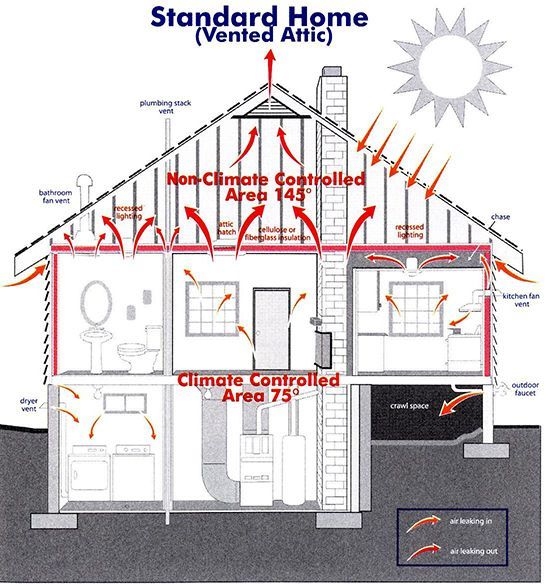
Standard Home
Vented attic graphic showing the natural convection process that allows air to be 'pulled' up through the house and escaping outside.
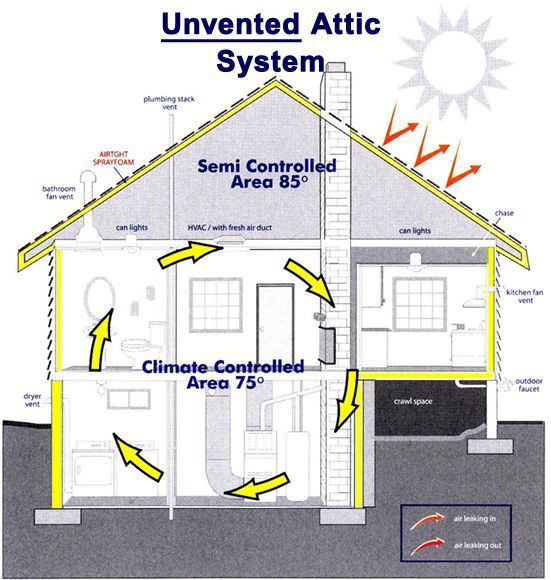
Standard Home
Unvented attic graphic showing an insulation roof deck and air tight attic that does not allow air to escape the building.
The benefits of including the attic in the insulated space are:
Lower risk of duct leakage and heat loss/gain from duct issues.
Air sealing is easier in the roof than in the ceiling.
Tests show energy costs are observably lower when the attic is sealed.
"Stack effect" from wind pressures is eliminated.
Dust and loose insulation are less likely to migrate down to the living space.
Why Attic Insulation Matters So Much in Chattanooga
Chattanooga sits in a mixed-humid climate: long, sticky summers, real cold snaps in winter, and big swings in between. A vented attic here can hit 130–140 degrees in summer — and if your ductwork and HVAC equipment live up there, they are working inside an oven. That heat radiates down through the ceiling, upstairs rooms never quite cool off, and your system runs longer cycles to keep up. In winter the same weak spots work in reverse, letting the heat you paid for escape through the roof deck. If your upstairs is hot in July, your bills climb every year, or your HVAC never seems to shut off, the attic is the first place we look.
Open-Cell vs. Closed-Cell Spray Foam for Attics
Both types insulate and air-seal in one step — the difference is density and where each one makes sense.
- Open-cell foam is the workhorse for residential roof decks. It expands to fill every gap between rafters, quiets outside noise, and stays vapor-open so the roof assembly can dry. For most Chattanooga homes, open-cell on the underside of the roof deck is the best performance per dollar.
- Closed-cell foam is denser, with a higher R-value per inch and built-in moisture resistance. We reach for it where space is tight or moisture is a factor — think crawl spaces, rim joists, and metal buildings.
Not sure which your home needs? That is exactly what our free on-site evaluation figures out: foam type, thickness, and whether your attic should stay vented or become an unvented, conditioned space.
Signs Your Attic Is Costing You Money
- Upstairs rooms that stay hot no matter where you set the thermostat
- Power bills that climb every summer
- HVAC running almost nonstop on hot afternoons
- Big temperature differences from room to room
- Old, thin, or patchy insulation on the attic floor
Any of those sound familiar? Get a free attic evaluation from a local Chattanooga insulation contractor — veteran-owned and serving the area for over 17 years.
Our Attic Insulation Process
- Free evaluation. We inspect your attic, ductwork, existing insulation, and ventilation, then give you a straight recommendation and a firm quote.
- Prep and removal. If old, damaged, or pest-contaminated insulation has to go, our insulation removal crew handles it before any foam is sprayed.
- Application. We spray foam to the underside of the roof deck, down the gable ends, and around the rim and soffits — sealing the whole attic into the insulated envelope.
- Inspection and walkthrough. We verify coverage and thickness, clean up, and show you exactly what was done.
What Does Attic Insulation Cost in Chattanooga?
Every attic is different, so honest pricing starts with a look at yours. The main factors are attic size and roof complexity, foam type and thickness, and whether old insulation needs to come out first. One thing works in your favor right now: the energy savings start with your very next power bill. Request a free quote and you will get an exact number, not a guess.
Attic Insulation FAQs
Do I have to remove the old insulation first?
Not always. If the existing material is dry and clean, it can often stay. If it is wet, moldy, or contaminated by pests, we remove it first — see our insulation removal service.
Will sealing my attic cause moisture problems?
Done right, the opposite. An unvented attic keeps humid outdoor air away from cold surfaces and ductwork, so there is less condensation, not more. Foam type and thickness are matched to our climate — that is the building-science part we obsess over.
How long does the job take?
Most residential attics are finished in one to two days, including prep and cleanup.
Is spray foam worth it if my HVAC is in the attic?
That is when it pays off fastest. Bringing ducts and equipment inside the insulated envelope means they stop fighting 140-degree air — shorter run times and less wear on the system.
Have a different question? Visit our FAQ page or call 423-710-2529. Foametix is veteran-owned and serves Chattanooga and 100 miles out.
Bonus rooms and knee walls: the coldest room in the house
Almost every two-story house around Chattanooga has one room that nobody can get comfortable — the room over the garage, the finished bonus room, the space behind the knee walls upstairs. It is freezing in January and unusable in August, and people assume they need more HVAC. They almost never do.
Here is what is actually happening. That room is surrounded by attic on three sides — short vertical knee walls left and right, and often an unconditioned space under the floor if it sits over a garage. Batts get stuffed into the knee wall cavities with nothing holding them against the drywall and nothing sealing the floor cavity behind them. Attic air at 135 degrees flows freely into that floor cavity, under the room, and up the back of the walls. The insulation is technically present and doing almost nothing, because there is no air barrier anywhere in the assembly.
The fix is to move the insulation to the roof deck and bring the whole space inside the envelope, plus seal the floor cavity at the knee wall so attic air stops circulating under the room. It is a specific, well-understood assembly, and it is one of the most satisfying jobs we do because the difference is immediate and the homeowner has usually been living with it for years.
Ductwork in the attic: the real reason to foam the roof deck
If your air handler and ducts are in the attic — and in most houses built here in the last forty years they are — that is the strongest argument for insulating at the roof deck rather than the ceiling.
A vented attic in July runs 130 to 140 degrees. Your ducts are carrying 55-degree air through it. Even well-insulated flex duct loses meaningful capacity across that gap, and every leaky joint is dumping conditioned air into a space you are not trying to cool — or worse, pulling 140-degree attic air into the return side and delivering it to your bedrooms. In winter the same thing runs in reverse.
Insulate at the roof deck and the attic settles within a few degrees of the house. The ducts are no longer the weak link. The system stops fighting the building, run times drop, and the equipment is not cycling as hard on the hottest afternoons. This is usually where the comfort improvement people actually notice comes from — more than the R-value on paper.
What happens to your attic ventilation
This is the question that makes people nervous, and it deserves a straight answer.
A vented attic is designed to run at outdoor temperature, with air entering at the soffits and leaving at the ridge. It works — provided the ceiling below it is genuinely airtight, which in an existing house it rarely is.
When we insulate at the roof deck, the attic stops being outdoors and becomes part of your conditioned space. The soffit and ridge vents get sealed as part of the assembly, because leaving them open while insulating the deck is the one genuinely bad outcome here — you get outdoor air washing across the back of your new insulation, and in a humid Tennessee summer that is where condensation forms. It is a common mistake on jobs we get called in to correct.
Done correctly, the assembly is code-recognised and has been standard practice in this climate for two decades. We will walk you through exactly what happens to your specific attic before we start, and if your house is a better candidate for a sealed ceiling and a vented attic, we will say so.
Attic insulation across Southeast Tennessee and North Georgia
We insulate attics throughout the region, including Chattanooga, Hixson, Ooltewah, East Ridge, Red Bank, Signal Mountain, Soddy-Daisy, Collegedale, Harrison, Cleveland, Fort Oglethorpe, Ringgold, Dalton and Rossville. See all the areas we serve, or look at insulation removal, crawl space encapsulation and new construction insulation.