
Metal Building Spray Foam Insulation
Metal structures are highly conductive, making proper insulation critical for energy efficiency, temperature control, and moisture prevention.
Prevent
Condensation & Heat Loss
At Foametix, we provide high-performance spray foam insulation for metal buildings in Chattanooga and surrounding areas, delivering superior energy efficiency and long-term savings. Whether you're insulating a new metal structure or upgrading an existing one, our expert team ensures a seamless installation custom to your building's needs.
WE KNOW HOW TO DO IT
WE KNOW HOW TO DO IT
Our Expert Insulation Solutions Work For:
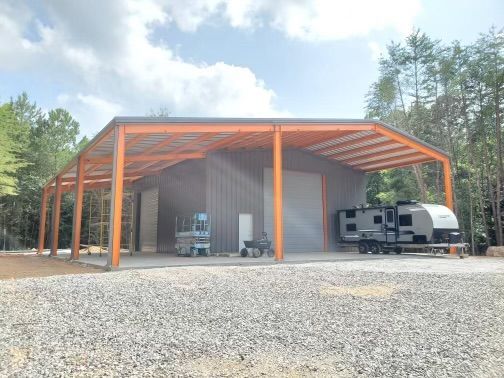
- Warehouses & manufacturing facilities – Maintain stable indoor temperatures while cutting heating/cooling costs for improved efficiency.
- Metal barns & agricultural buildings –Prevent condensation, rust, and mold growth, protecting equipment, livestock, and stored goods.
- Garages & workshops – Enjoy year-round comfort, eliminate drafts, and create a more efficient workspace in any season.
WE KNOW HOW TO DO IT
Why Choose
Foametix Spray Foam Insulation?
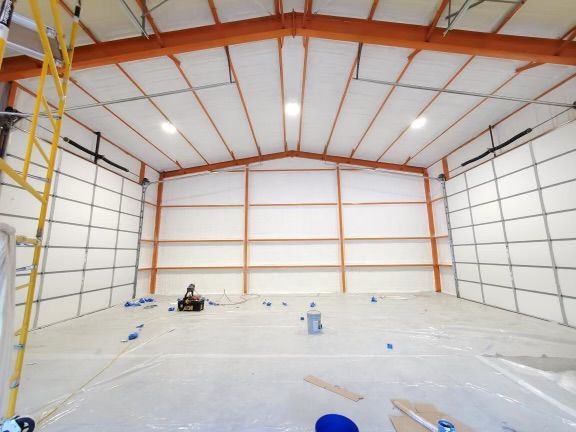
Our closed-cell spray foam acts as a thermal and vapor barrier, sealing every gap and stopping heat transfer. Unlike fiberglass batts, which trap moisture and sag over time, spray foam remains durable, mold-resistant, and highly effective for decades.
If you need spray foam insulation for a metal building in Chattanooga or within a 100 mile radius, Foametix delivers expert service and lasting results. Schedule a free consultation today!
Why metal buildings sweat in Chattanooga
If you own a shop, barn or pole building around Chattanooga, you have probably walked in on a spring morning and found water dripping off the underside of the roof. Nothing is leaking. That is condensation, and it is the single most common problem we get called about on steel buildings in the Tennessee Valley.
Here is what is happening. Steel panel has essentially no resistance to heat flow. Overnight the roof radiates heat to the sky and the panel drops below the dew point of the air inside the building. Warm, humid air — and there is plenty of it in this valley from April through October — touches that cold steel and gives up its moisture. The panel is now the coldest surface in the building, so it collects the water first.
That water lands on whatever is under it. Equipment, tools, hay, inventory, the truck you just painted. Over time it rusts fasteners and purlins from the inside out and grows mold on anything organic. Ventilation alone will not solve it, because on a humid morning the outside air you pull in is carrying the same moisture you are trying to get rid of.
The fix is to stop warm air from ever reaching cold steel. Closed-cell spray foam applied directly to the underside of the panel does that in one step: it insulates the steel so it never gets that cold, and it acts as its own vapor barrier so moisture cannot get behind it. There is no gap for air to move through, because the foam is bonded to the panel.
Open-cell or closed-cell for a steel building?
For a metal building the answer is almost always closed-cell, and it is worth understanding why so you can tell whether a bid you are looking at makes sense.
Closed-cell foam is dense and rigid. At the thickness we typically apply it, it is a vapor retarder in its own right, so it stops moisture from migrating to the steel. It also adds racking strength to the panel and it will not hold water if it ever does get wet. Open-cell foam is softer, breathes, and is a good product — we use a lot of it in residential attics — but it lets vapor through. On a steel roof deck that means you have moved the condensation problem behind the insulation instead of solving it.
The exception is an interior wall or ceiling in a conditioned metal building where the roof is already handled and you are mainly after sound and temperature. There, open-cell can make sense and it costs less. We will tell you on-site which one your building actually needs, and we will tell you if you do not need us at all.
What we insulate in a metal building
- Roof deck — the underside of the panel, between and over the purlins. This is where condensation forms and where most of your heat gain comes from in July. If you only do one thing, do this.
- Walls — girts and panel. Adds real comfort in a shop you actually work in, and cuts the radiant heat coming off a sun-facing wall.
- Ceiling or flat lid — if the building has a drop ceiling and you only condition the space below it, insulating there can be cheaper than doing the whole roof.
- Around openings — overhead doors, man doors and eave lines are where air moves in a steel building. Sealing these is often what makes the difference between "better" and "actually comfortable."
Spray foam versus the alternatives
Vinyl-backed blanket insulation. This is what most metal buildings come with from the manufacturer. It is inexpensive and it works on day one. The problem is that it is compressed at every purlin, it sags over time, and once the facing tears anywhere — and it always does — moist air gets behind it and condenses on the panel exactly the way it would with no insulation at all. We remove a lot of sagging, stained blanket.
Fiberglass batts. Same issue, worse. Batts do not air seal, they hold water when they get wet, and they lose most of their R-value when compressed or damp.
Rigid board. Good R-value per inch, but every seam and every fastener penetration is a path for air and moisture. On the irregular geometry of a steel building, getting it truly sealed is difficult and labor-intensive.
Closed-cell spray foam. Bonds to the panel, seals every seam and fastener, does not sag, does not absorb water, and does not need replacing. It costs more up front than a blanket. It is the only one of these that actually ends the condensation problem rather than delaying it.
What metal building insulation costs
Every steel building is different — height, panel profile, purlin spacing, whether there is existing insulation to tear out, and how much of the building you actually want conditioned. Anyone who quotes you a number over the phone without seeing it is guessing.
What we can tell you is how we price it. We come out, measure the building, and give you a written price before we touch anything. That evaluation is free and there is no obligation attached to it. The number you get is the number you pay — we do not start a job and then find reasons to add to it.
The variables that move the price most: total square footage of roof and wall, the thickness required for your use of the building, whether old blanket insulation has to come down first, and access. A clear, empty shop bay is a very different job from a working shop packed to the walls.
How the job goes
- Free on-site evaluation. We look at the building, talk through how you use it, and identify whether you have an active condensation problem or are trying to prevent one.
- Written price. Before anything happens. Line-itemed so you can see what you are paying for.
- Prep. We mask and protect what stays, and remove old insulation if it needs to come out.
- Spray. Applied by our own crew — we do not subcontract. Most metal building jobs are one to three days depending on size.
- Walkthrough. We show you what was done before we leave.
Metal building insulation FAQs
Will spray foam stop the condensation in my metal building?
Yes, when it is closed-cell and applied directly to the panel at adequate thickness. The reason it works is that it does two jobs at once: it keeps the steel from dropping below the dew point, and it forms its own vapor barrier bonded to the panel so there is no gap for humid air to reach cold steel. Insulation that leaves an air gap behind it does not solve condensation.
Can you spray foam over insulation that is already in my building?
Usually not, and you would not want us to. Old vinyl-backed blanket is typically sagging and often already holding moisture. Foam applied over it is only bonded to the facing, not the steel, and any water trapped behind stays trapped. In most cases we take the old material down first. We will tell you on-site which situation you are in.
Do I have to insulate the whole building?
No. Plenty of our customers do the roof only, or condition one bay of a larger shop. The roof deck is where the condensation and most of the summer heat gain happen, so if budget is the constraint, that is where the money goes first.
Will it work on a pole barn with wood framing?
Yes. Pole barns with steel skin have the same condensation dynamic as a fully steel building. The framing changes how we approach it but not whether it works.
How long does spray foam last in a metal building?
It does not sag, settle, or degrade the way blanket and batt insulation do. Applied correctly it lasts the life of the building. There is no maintenance and nothing to replace.
Do you insulate metal buildings outside Chattanooga?
Yes — we work Chattanooga and roughly 100 miles out, which covers most of Southeast Tennessee and North Georgia. Farm and shop buildings are a large share of what we do, and a lot of them are well outside the city.
Metal building insulation across Southeast Tennessee and North Georgia
We insulate shops, barns, warehouses and pole buildings throughout the region, including Chattanooga, Cleveland, Athens, Dayton, Dunlap, Jasper, Soddy-Daisy, Ooltewah, Dalton, Ringgold, LaFayette, Summerville, Calhoun and Trenton. See all the areas we serve, or read about why metal buildings sweat and how to stop it.