
Wall Insulation for Existing Homes & Retrofits
Are you aiming to boost your home's energy efficiency, minimize external noise, and elevate overall comfort? Our wall insulation can achieve all of this for you!
Reduce Energy
Loss & Noise
When upgrading home insulation, walls should be the last priority, as most heat loss occurs through the attic and crawlspace. However, if your home has little or no wall insulation, improving it can significantly boost energy efficiency, enhance indoor comfort, and reduce outside noise. Proper wall insulation helps maintain stable temperatures, lowers heating and cooling costs, and creates a quieter, more comfortable living space. While not the first step, it's a valuable upgrade for homes lacking adequate insulation.
WE KNOW HOW TO DO IT
WE KNOW HOW TO DO IT
Why Choose Foametix For Your Wall Insulation?
Many companies promote injection foam wall insulation, but Foametix does NOT use injection foam. Injection foam is a wet, pre-expanded material, similar to shaving cream. While it may be an option for homes with zero pre-existing insulation, it doesn’t provide the same air-sealing and thermal benefits as traditional spray foam insulation.
- Enhance energy efficiency – Reduce drafts and maintain stable temperatures to lower utility bills, increase efficiency, and lower strain on your HVAC unit.
- Improve soundproofing – Reduce outside noise for a quieter home.
- Upgrade older homes – Retrofit insulation without major renovations.
Start with this: walls are usually not your problem
We are an insulation company and we are about to talk you out of buying insulation. Read this part before you spend anything.
In a typical Chattanooga house, the attic and the crawl space are where the money is going. Heat rises and leaves through the ceiling plane. Humid air comes up out of the crawl space and into the living space. Those two assemblies drive most of your utility bill, most of your comfort complaints and essentially all of your moisture problems. Walls are third.
If your attic has not been addressed and your crawl space is open to the dirt, spending your budget on walls is spending it in the wrong place. You will feel very little for the money. We will tell you that on-site rather than sell you the job, and we would rather do your attic this year and your walls in three years than take the bigger check today and have you tell your neighbor it did not do much.
When walls are worth doing: the house has little or no wall insulation at all — common in homes built before the mid-1970s around here. You have one wall that is noticeably cold or hot, usually a west or north exposure. You are gutting a room or the whole house anyway and the cavities are open. Or noise is the actual complaint — a bedroom on a busy road, a shared wall, a home office.
We do not use injection foam, and here is why
A lot of companies advertising retrofit wall insulation are selling injection foam — a wet, pre-expanded product with roughly the consistency of shaving cream, pumped into closed wall cavities through holes drilled in the siding or drywall. It is popular because it is the easy sell: no demolition, done in a day.
Foametix does not install it. Our reasoning:
- You cannot see what you are getting. The cavity is closed. Nobody — not you, not the installer — can verify coverage behind the wall, and cavities are rarely empty and rarely uniform. Wiring, blocking, plumbing and old settled batt material all create voids the pump cannot fill.
- It is wet going in. It carries a significant amount of water that has to leave the assembly. In a closed cavity in a humid climate, that moisture has limited places to go.
- It does not air seal like spray foam. It fills volume. That is not the same thing as sealing the air paths at the top plate, the bottom plate and the penetrations, which is where the actual leakage happens.
- It cannot be inspected or corrected. If it went in badly, you find out by living in the house.
None of that means injection foam is worthless — for a genuinely empty cavity in a house that will never be opened up, it is better than nothing. It is just not a product we are willing to put our name on, because we cannot stand behind work we cannot see.
What we do instead
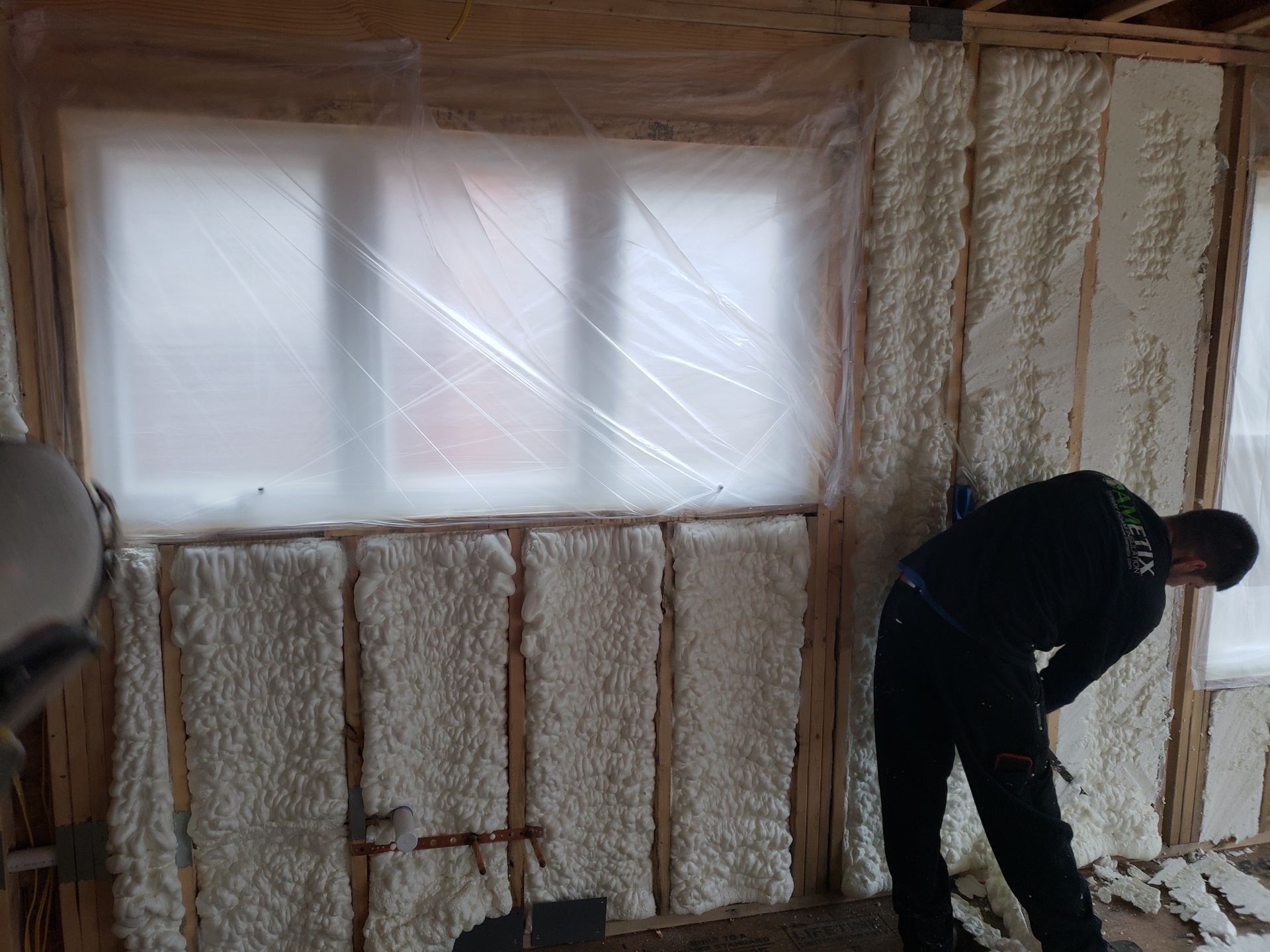
Open cavities get spray foam. If the wall is open — new construction, a gut renovation, a room being remodeled, siding coming off — that is when a wall gets done properly. We can see every bay, seal every penetration, and get complete coverage at the top and bottom plates where the air actually moves. This is the right answer and it is worth planning a remodel around.
Closed cavities get an honest conversation. If the walls are closed and staying closed, we will tell you what your realistic options are, including the ones that are not us. Often the better recommendation is to put that budget into the attic and crawl space, where we can do work we can verify.
Sound is a legitimate reason on its own. Interior partition walls — around a bedroom, a bathroom, a media room, a home office — are a place where open-cell foam earns its keep even though there is no energy argument for it. If quiet is what you are buying, say so and we will scope it that way.
Retrofit insulation for older Chattanooga homes
There is a lot of pre-1975 housing stock in this area — St. Elmo, North Chattanooga, Highland Park, Red Bank, East Ridge, plus farmhouses all through the outlying counties. Many of these houses have empty wall cavities, no air sealing anywhere, a vented crawl space open to bare dirt, and whatever insulation was blown into the attic decades ago.
The retrofit sequence that actually works on a house like that:
- Crawl space first if it is open to dirt or you have humidity, musty smell, or cupping floors. Everything above it is downstream of this.
- Attic second. Air seal the ceiling plane, then insulate — or move to the roof deck if there is HVAC up there.
- Band joists and rim. Cheap, fast, and disproportionately effective.
- Walls last, and ideally when they are open for another reason.
Older houses also need a word of caution: a house that has been leaky its entire life has been drying through those leaks. Tightening one part of the envelope without thinking about the whole assembly can move a moisture problem rather than solve it. That is exactly why we look at the whole house before we quote a piece of it.
What wall insulation costs
Wall work prices by the square footage of wall area, the product the assembly calls for, and above all by access — open cavities are a completely different job from closed ones. A single interior partition wall for sound is a small job. A whole-house retrofit during a gut renovation is not.
We come out, look at the actual walls, and give you a written price before we touch anything. The evaluation is free. If the honest answer is that your money belongs somewhere else in the house, that is what you will hear.
Wall and retrofit insulation FAQs
Can you insulate my walls without tearing out the drywall?
Not with spray foam, and we do not use injection foam. Spray foam requires an open cavity so we can see and verify the work. If your walls are closed and staying closed, we will tell you honestly what your options are — and often the better recommendation is to put that budget into the attic or crawl space instead.
Why won't you install injection foam when other companies will?
Because we cannot see it. It goes into a closed cavity through drilled holes, so coverage cannot be verified by us or by you, it carries water into the assembly, and it fills volume rather than sealing air paths. We are not comfortable warranting work we cannot inspect.
Will wall insulation lower my power bill?
Some, if the walls currently have nothing in them. But if your attic and crawl space have not been addressed, walls will be the smallest of the three by a wide margin. Do those first and you will feel the difference more for the same money.
Does spray foam in the walls help with noise?
Yes, and it is often the better reason to do it. Open-cell foam is a good sound deadener — noticeably effective around bedrooms, bathrooms, media rooms and home offices, and on walls facing a busy road. If quiet is the goal, tell us and we will scope the job for that rather than for R-value.
My house is from the 1950s and has nothing in the walls. Is it worth it?
It can be, especially if you are remodeling and the walls are coming open anyway. But older houses need the whole envelope thought through, not one piece of it — a house that has always dried through its leaks can develop problems if you tighten one assembly in isolation. That is what the on-site evaluation is for.
Do you insulate garage walls and workshops?
Yes. Attached garage common walls, detached shops and bonus rooms over garages are all common jobs for us — and the room over the garage is the single most frequent comfort complaint we get called about in this area.
Wall and retrofit insulation across Southeast Tennessee and North Georgia
We insulate walls and retrofit older homes throughout the region, including Chattanooga, Red Bank, East Ridge, Signal Mountain, Hixson, Soddy-Daisy, Ooltewah, Cleveland, Athens, Fort Oglethorpe, Rossville, Ringgold, Dalton and LaFayette. See all the areas we serve, or start where it matters most — attic insulation and crawl space encapsulation.